
Case Study: Dartmouth Suburban Home, 5.72 kW
13-panel rooftop solar install on a single-family home in Dartmouth. 66% of annual usage offset by solar, $32,000 in projected 25-year net savings, and a payback period of roughly 13 years.
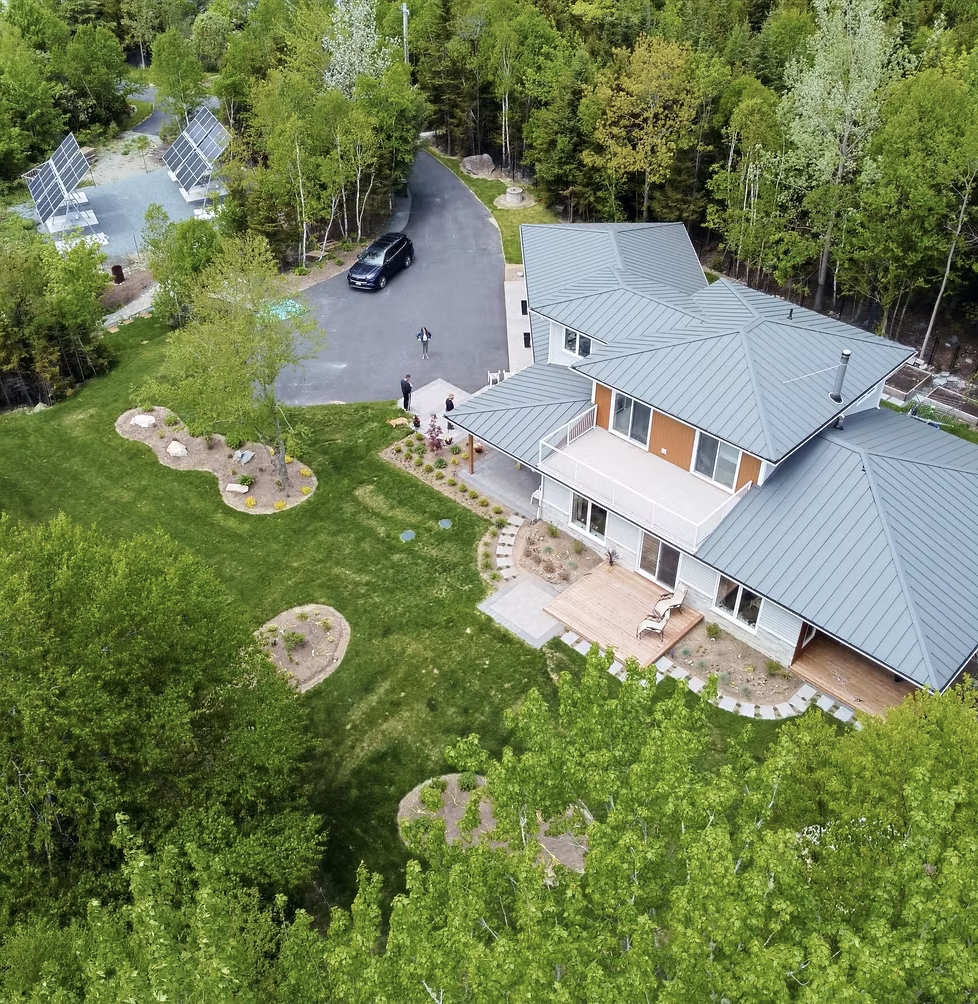
Single-Family Dartmouth Home with Average Usage
The property is a typical Dartmouth split-level home in the Woodlawn / Cole Harbour area. The homeowner's annual electricity usage was 9,880 kWh, with a monthly NS Power bill averaging $169 (including the $19.17 base charge). The owner wanted to lock in their electricity cost against future rate hikes and reduce their carbon footprint without taking on financing risk.
The roof had a clean south-facing rear slope with no significant shading, ideal for a moderate-sized solar PV system. The household had not yet adopted an EV or heat pump, so usage was on the lower end of the HRM range, which influenced the right-sizing of the system.
System Specifications
- Solar Panels: 13 x LR7-54HGBB 440W monocrystalline modules (LONGi or equivalent Tier-1 brand)
- Microinverters: 7 dual-module microinverters (Hoymiles or Enphase IQ8)
- Monitoring: 1 gateway with mobile app and web client
- Racking: Anodized aluminum CSA-certified rail system with critter guards
- Warranties: 30-year linear performance on panels, 20-25 year on microinverters, 20-year on racking
- System efficiency: 1,133 kWh per kW per year (above the NS average of ~1,090 due to favourable roof orientation)
25-Year Cumulative Math
All figures reflect 2026 NS Power rates (18.187¢/kWh + $19.17 monthly base charge), approved rate increases for 2026/2027, and a 3.5% annual escalation thereafter. No expired rebates included.
System Investment
Energy & Bill Impact
25-Year Cumulative
Footnotes: NS Power rate model uses 18.187¢/kWh January 2026 starting point, NSEB-approved 3.8% increase in 2026 and 4.1% in 2027, then 3.5% annual escalation thereafter. Solar offset model uses NS Power's 1:1 net metering with 12-month rollover. Monthly base charge ($19.17) is paid regardless of solar generation. Numbers are non-binding estimates. Real results depend on weather, equipment, and program continuity.
Same Project on HRM Solar City PACE
If the homeowner had used Halifax Solar City PACE financing instead of cash, the monthly cash flow looks different but the lifetime math improves further because the property tax-based repayment structure has tax advantages and zero impact on personal credit. Here is the same project financed over 10 years at 4.75% fixed.
Monthly Cash Flow (Years 1-10)
After PACE Payoff (Years 11-25)
The cash purchase shows higher net savings because there is no financing interest paid. The PACE-financed version still nets significant savings, but the bigger advantage is the $0 upfront cost, which is what makes solar accessible to homeowners without $19,000+ in cash to deploy. Cash flow during years 1 to 10 is moderately negative on a monthly basis (about $100/month more than the current bill), but this is essentially prepaying your electricity at locked-in rates. Years 11 to 25 then flow strongly positive as NS Power rates continue rising while the system keeps producing.
Tier-One Components, NS-Tested
The equipment specified for this Dartmouth install is the standard Polaron-grade Tier-1 product line used across the region in 2024 and 2025. Every component carries strong warranties and has been deployed across thousands of NS homes.
LR7-54HGBB 440W Panels
Monocrystalline modules with low-irradiance Canadian-weather optimization, zero LID degradation, and 30-year linear performance warranty.
Microinverters (Hoymiles or Enphase)
97.5% efficiency, module-level monitoring, panel-level shading optimization, 20 to 25-year warranty.
Anodized Aluminum Racking
CSA-certified, treated for rust, tested on 5,000+ Canadian homes. Complimentary critter guards included.
Monitoring System
Web and mobile dashboard for tracking individual panel production. 24/7 live data and remote troubleshooting access.
What This Case Teaches
- Right-sizing matters. A 5.72 kW system at 66% offset makes sense for a 9,880 kWh/yr household. Oversizing the array would not have produced additional revenue because surplus credits forfeit after 12 months.
- Cash buyers win on lifetime math. No financing interest paid means more savings stay with the homeowner. But PACE financing is what makes solar accessible to most homeowners who do not have the cash on hand.
- The cost is essentially prepaying your bill. Whether you pay cash or finance through PACE, you are buying 25+ years of electricity at locked-in 2026 prices instead of riding NS Power's escalating rate curve. That hedge alone, separate from the savings, is valuable.
- Closed rebates do not kill the math. The SolarHomes rebate ($3,000) being gone reduces savings by about $3,000 over 25 years. The remaining $31,000+ in savings is still strong, driven primarily by NS Power's 1:1 net metering.
Build the Same Analysis for Your Home
Send us a recent NS Power bill. We will model your specific roof, factor in your municipality's PACE options, and email you transparent numbers like the ones above within a week.
Or call directly: (902) 707-5253